Skip to the main content.

2 min read

AI-Powered Analysis of Open-Ended Responses

AI-Powered Analysis of Open-Ended Responses

In the real estate industry, there is great value in understanding what tenants truly think – not only through quantitative data, but also through their own written words. More than 70% of respondents leave open text comments in surveys, making these responses one of the best sources for understanding the multiple-choice answers and taking the right actions – in properties, neighborhoods, or for individual tenants.

More Efficient Text Analysis

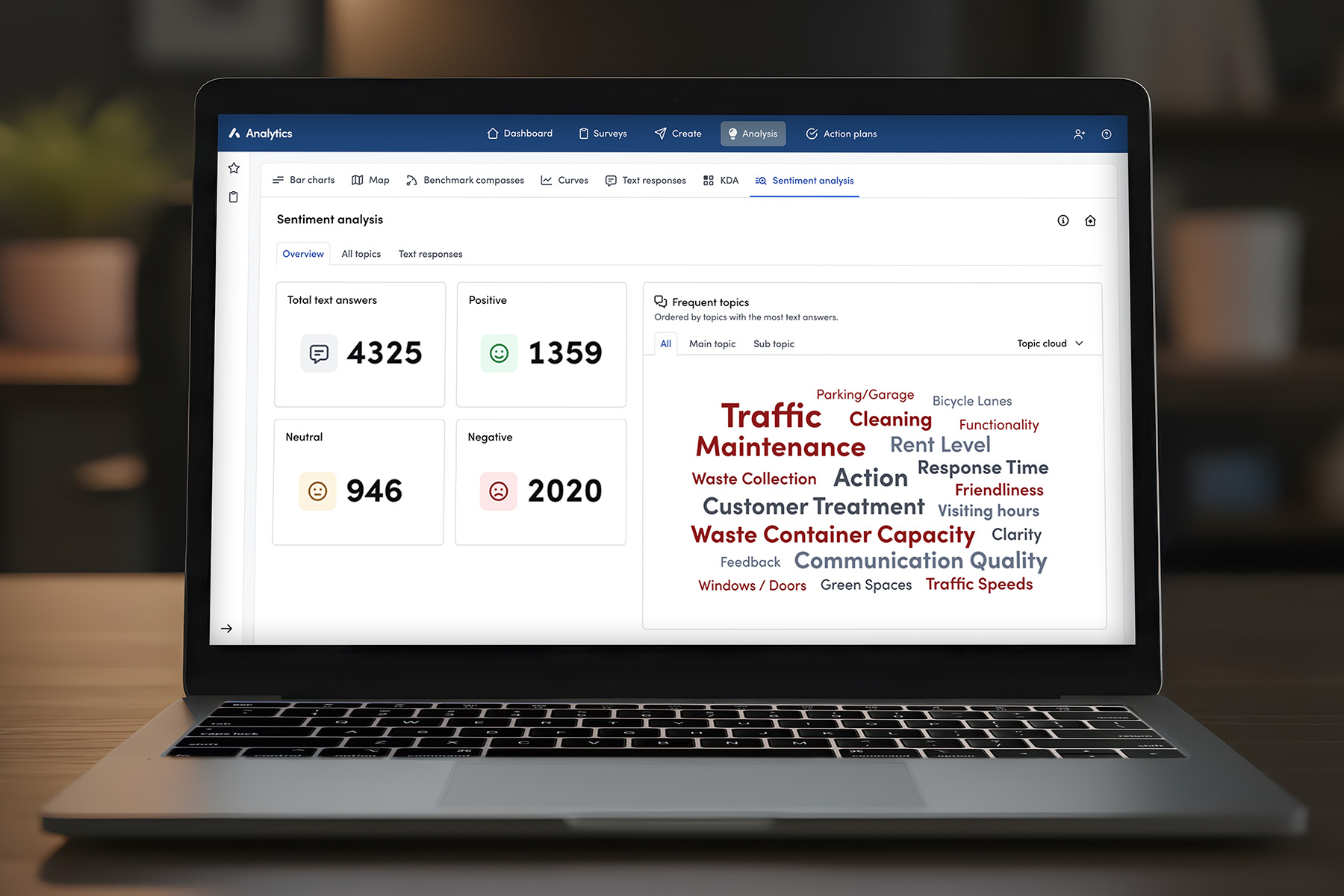
Open-ended responses are invaluable – but time-consuming to analyze. That’s why we’ve developed a new AI-based service in AktivBo Analytics, which automatically processes all open-ended responses, links them to the correct question area in the survey, assesses whether the comments are positive or negative, and highlights those that are actionable. This gives you a quick overview of which topics are most relevant, and which areas should be prioritized.

Understanding and Comparing Tonality in Tenants’ Own Words

The service analyzes not only what is said, but also how it is said—whether the tone is positive, neutral, or negative. This gives real estate companies deeper insight into their tenants' experiences and provides valuable data for comparisons over time or between different properties and areas. This makes it easy for you to measure the effect of improvements or act quickly when things are going in the wrong direction.

Focus on What’s Actionable

Not all open-ended responses can be translated into action. The service is trained to identify actionable feedback, i.e., comments that contain concrete suggestions for improvement or clear requests from tenants.

These comments are highlighted visually in the platform, making it easy to prioritize correctly – whether it's a specific problem in one property, recurring comments in a specific area, or overarching issues that are relevant at a broader organizational level.

Examples of How the Service Categorizes Open-Ended Responses

  • Lack of Follow-Up: Several tenants write that they do not receive sufficient feedback after submitting a maintenance request via the website. The service recognizes this as an issue related to "Information", under the subcategory "Feedback", and marks it as negative.

    Value: By clearly categorizing and visualizing this type of feedback, the company can quickly see where in the process the problem arises. It also becomes easier to identify an appropriate action – for example, introducing automatic confirmations when a maintenance request is registered, or reviewing routines for follow-up.
  • Temperature and Ventilation: Tenants in an office property describe uneven temperature conditions during the winter months. The service categorizes this as a negative text response within the area of "Premises", under the subcategory "Winter Temperature".

    Value: By filtering and identifying recurring comments within the same category, users gain a clear picture of frequency and can see, for example, that problems with heating during winter occur so often that they should be prioritized for investigation and action.
  • Contact: Several tenants write that it is difficult to reach the right person when they need assistance or have questions. The service places these comments in the category "Contact", under the subcategory "Availability".

    Value: The analysis clearly shows that tenants experience shortcomings in how easily they can reach their contact person. This helps the company focus on the right measures – for example, clarifying contact channels, introducing shared contact points, or ensuring that incoming requests are quickly routed to the right person.

From Insight to Action – Seamlessly in the Platform

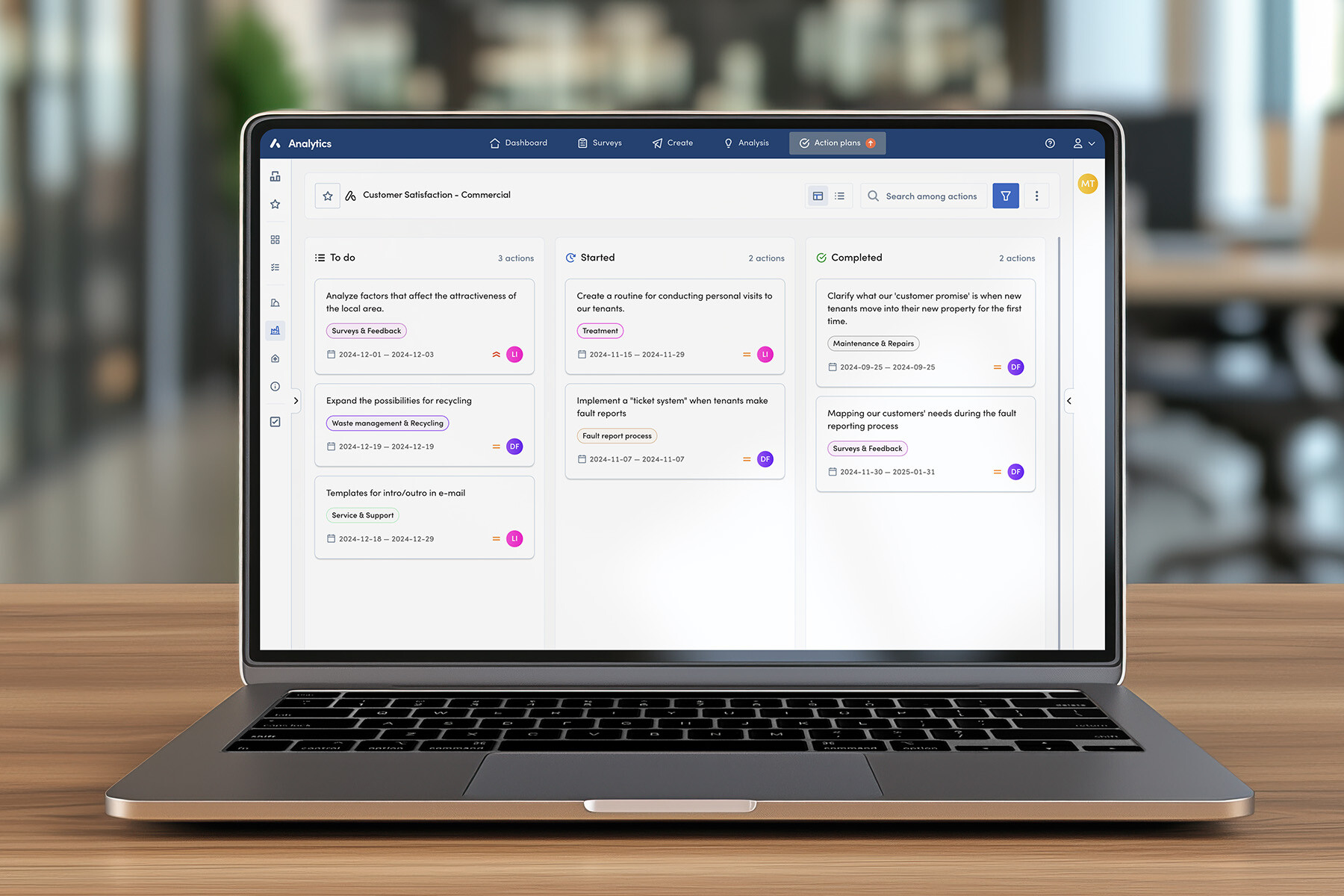
It’s not enough to understand what tenants think – you must also be able to act on it. Each open-ended response can therefore be linked to individual survey questions, allowing actionable recommendations to be presented directly to the user. You don’t just receive analysis – you get a concrete next step, right where the insight emerges. This makes it easier to create relevant action plans and drive improvements with clear support from dat.

More Time for What Matters

Manually reviewing thousands of open-ended responses takes time and shifts focus from what truly creates value.
By automating the analysis, time is freed up for what’s most important – acting on insights.

The service helps you quickly identify patterns, set the right priorities, and implement actions that make a real difference for tenants. At the same time, it reduces the risk of missing important feedback, leading to more accurate decisions and faster improvements in properties and areas.

Want to know more? Get in touch with us!

AktivBo launches new action planning tool for predictive analytics

1 min read

AktivBo launches new action planning tool for predictive analytics

Almost all professional real estate companies and property owners conduct tenant surveys to increase efficiency, customer satisfaction and improve...
How AktivBo Turns AI Into Tangible Business Results

How AktivBo Turns AI Into Tangible Business Results

Artificial intelligence is rapidly enabling new services that help improve the tenant experience. By analyzing vast amounts of qualitative tenant...
The New AktivBo Analytics – Smarter, Faster, Easier to Use

The New AktivBo Analytics – Smarter, Faster, Easier to Use

{% video_player "embed_player" overrideable=False, type='hsvideo2', hide_playlist=True, viral_sharing=False, embed_button=False, autoplay=False,...